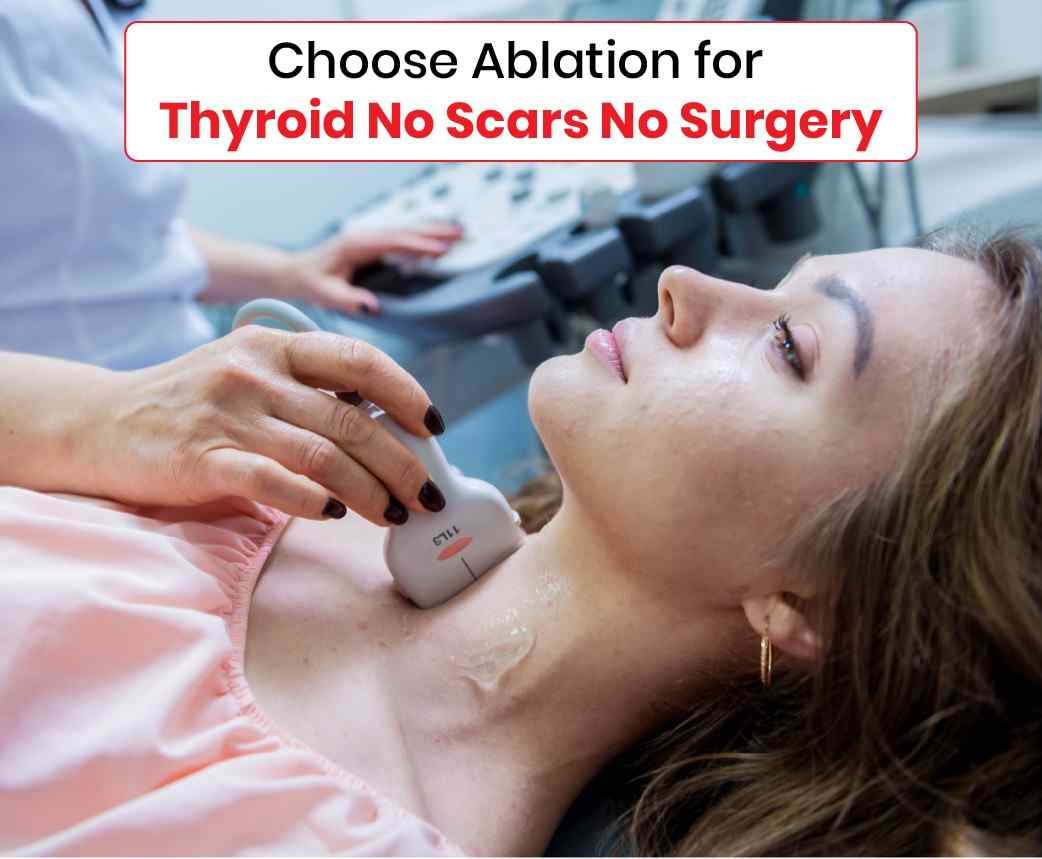
Blog > Vascular Diseases > Choose Ablation for Thyroid No Scars No Surgery
Choose Ablation for Thyroid No Scars No Surgery
18-October-2025Category: Vascular Diseases
Thyroid disorders, including thyroid nodules, can significantly impact one’s health and quality
of life. While surgical removal of the thyroid has been a traditional approach to managing
thyroid nodules, advancements in medical technology have introduced a less invasive and equally
effective alternative: ablation therapy. In this blog, we will explore the benefits of ablation
over thyroid removal, highlighting why patients should consider this innovative treatment
approach for thyroid disorders.
Understanding Thyroid Nodules: Thyroid nodules are common, often benign growths that develop
within the thyroid gland. While many nodules are harmless and require no treatment, some can
cause symptoms such as difficulty swallowing, neck discomfort, or changes in voice tone. In some
cases, thyroid nodules may be associated with thyroid dysfunction or even thyroid cancer,
necessitating further evaluation and treatment.
Get Your First Doppler Scan FREE — Worth ₹4,500!
Complications of Thyroid Nodules: Left untreated, thyroid nodules can lead to various
complications, including:
Thyroid Dysfunction: Some nodules may disrupt the normal production of thyroid hormones, leading
to symptoms of hypothyroidism (underactive thyroid) or hyperthyroidism (overactive thyroid).
Compression Symptoms: Larger nodules can compress nearby structures in the neck, causing
difficulty swallowing, breathing, or speaking.
Cosmetic Concerns: Nodules located near the surface of the neck may be visible or palpable,
causing cosmetic concerns for some patients.
Risk of Thyroid Cancer: While most thyroid nodules are benign, a small percentage may harbor
thyroid cancer, necessitating further evaluation and treatment.
Confused about treatment options? Our experts will guide you step by step.
Challenges of Thyroid Removal:
Historically, surgical removal of the thyroid, known as thyroidectomy, has been the primary
treatment for thyroid nodules, especially those suspected to be cancerous. However,
thyroidectomy comes with several challenges and potential complications, including:
Risk of Complications: Thyroidectomy is a major surgical procedure that carries inherent risks,
including bleeding, infection, damage to surrounding structures (such as the parathyroid glands
or recurrent laryngeal nerves), and scarring.
Extended Recovery Time: Recovery from thyroidectomy may require several weeks, during which
patients may experience pain, discomfort, and limitations on daily activities.
Hormone Replacement Therapy: Complete removal of the thyroid gland necessitates lifelong hormone
replacement therapy to maintain thyroid hormone levels, leading to ongoing medication management
and potential side effects.
Cosmetic Considerations: Thyroidectomy leaves a visible scar on the neck, which may cause
distress for some patients, particularly if the scar is prominent or keloid-prone.
Get Your First Doppler Scan FREE — Worth ₹4,500!
Advantages of Ablation Therapy: Ablation therapy offers a less invasive and highly effective
alternative to thyroidectomy for the treatment of thyroid nodules. Here are some key benefits of
ablation:
Minimally Invasive: Ablation procedures, such as radiofrequency ablation (RFA) or laser
ablation, are performed using needle-like probes inserted directly into the thyroid nodule under
ultrasound guidance. This minimally invasive approach reduces the risk of complications and
shortens recovery time compared to surgery.
Preservation of Healthy Thyroid Tissue: Unlike thyroidectomy, which involves removing the entire
thyroid gland, ablation therapy selectively targets and destroys only the problematic nodule
while preserving surrounding healthy thyroid tissue. This helps maintain normal thyroid function
and eliminates the need for lifelong hormone replacement therapy.
Outpatient Procedure: Ablation procedures are typically performed on an outpatient basis,
allowing patients to return home the same day and resume normal activities shortly thereafter.
The procedure itself is relatively quick, with minimal discomfort and downtime.
High Success Rates: Ablation therapy has been shown to be highly effective in reducing the size
of thyroid nodules, alleviating symptoms, and improving overall quality of life for patients.
Studies have demonstrated excellent long-term outcomes with low rates of recurrence.
To conclude, Thyroid nodules can pose significant challenges and complications for patients, but
advancements in medical technology have introduced a safer, less invasive alternative to
surgical removal: ablation therapy. By selectively targeting and destroying problematic nodules
while preserving healthy thyroid tissue, ablation offers patients a highly effective treatment
option with minimal risk and rapid recovery.
If you’re facing the dilemma of thyroid nodule management, consider discussing ablation therapy
with your healthcare provider to explore the best treatment approach for your individual needs.
Tags: ablation for thyroid, Thyroid Ablation, Thyroid ablation for women, Thyroid and women,
Thyroid and women health, thyroid conditions, Thyroid disease
For any unanswered questions, reach out to our support team via
email. We’ll respond as soon as possible to assist you.
For Enquiry
✉
info@avisvascularcentre.com
☎
+91 80089 49900
Is ablation therapy a safe alternative to thyroid surgery?
−
Yes. Ablation therapy is a safe and well-established treatment for selected thyroid nodules. It is
minimally invasive, performed under imaging guidance, and has a significantly lower risk of
complications compared to traditional thyroid surgery.
Will I need lifelong thyroid medication after ablation?
+
In most cases, no. Unlike thyroid removal, ablation targets only the thyroid nodule and preserves
healthy thyroid tissue. This allows the thyroid gland to continue producing hormones naturally,
reducing or eliminating the need for lifelong hormone replacement therapy.
Which thyroid nodules are suitable for ablation therapy?
+
Ablation is best suited for benign thyroid nodules that cause symptoms such as neck discomfort,
swallowing difficulty, voice changes, or cosmetic concerns. It may also be considered in selected
cases where surgery is not ideal. Final eligibility is determined through ultrasound and biopsy.
How long does recovery take after thyroid ablation?
+
Recovery is usually very quick. Most patients go home the same day and return to normal activities
within 24–48 hours. Mild soreness or swelling may occur but typically resolves within a few days.
Is ablation as effective as thyroid surgery?
+
Yes, for appropriately selected patients. Ablation has shown high success rates in shrinking thyroid
nodules, relieving symptoms, and improving quality of life, with low recurrence rates—without the
risks and long-term consequences of removing the thyroid gland.