Blog > Diagnosis and Treatment >CLaCS Treatment for Spider Veins
CLaCS Treatment for Spider Veins
18-October-2025Category: Diagnosis and Treatment
Spider veins, those small red, blue, or purple veins that appear on the legs and face, can be a
cosmetic concern and sometimes cause discomfort. While traditional treatments like sclerotherapy
and laser therapy have been used to address this issue, a newer technique known as CLaCS
(Cryo-Laser and Cryo-Sclerotherapy) is gaining traction for its effectiveness and minimal
invasiveness. Let’s explore what CLaCS is and why it’s becoming a popular choice for treating
spider veins.
Get Your First Doppler Scan FREE — Worth ₹4,500!
What is CLaCS?
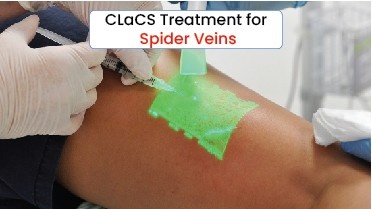
CLaCS is an innovative treatment method that combines laser therapy, sclerotherapy, and
cryotherapy into one comprehensive procedure. Here’s how it works:
Laser Therapy: A transdermal laser is used to target and heat the spider veins
through the skin.
This process causes the blood within the veins to coagulate, leading to the collapse of the
vessel walls. Over time, these treated veins are reabsorbed by the body, effectively reducing
their visibility.
Cryotherapy: To enhance patient comfort and protect the skin, a cooling device
blows a
continuous stream of cold air onto the treatment area. This cryotherapy element helps to numb
the skin and reduce the discomfort typically associated with laser treatments.
Sclerotherapy: After the laser treatment, a sclerosant—a specialized chemical
solution—is
injected directly into the spider veins. This solution irritates the vein lining, causing the
vein to close off and eventually be absorbed by the body.
Confused about treatment options? Our experts will guide you step by step.
Ideal Candidates for CLaCS
CLaCS is suitable for a wide range of individuals with spider veins, particularly those who want
a less invasive treatment or have not had success with other methods. It is especially effective
for treating spider veins on the legs, but it can also be used on the face and other
areas.
However, not everyone is a candidate for CLaCS. Those with certain medical conditions, such as
severe venous insufficiency or active skin infections, may not be suitable for the procedure. A
consultation with a qualified vein specialist is essential to determine if CLaCS is the right
option for you.
What to Expect During and After the Procedure
A CLaCS procedure typically takes about 30 to 60 minutes, depending on the extent of the
treatment area. The process is relatively straightforward: the skin is cleansed, and a numbing
cream may be applied to ensure comfort. During the treatment, you may feel a mild tingling
sensation from the laser and a cooling effect from the cryotherapy, but significant pain is
rare.
After the procedure, you might notice some mild redness, swelling, or bruising, but these are
usually temporary and resolve quickly. Wearing compression stockings for a short period
post-treatment can help support the veins and promote healing.
CLaCS is a cutting-edge treatment that offers a minimally invasive, effective solution for
spider veins with minimal discomfort and downtime. By combining laser therapy, cryotherapy, and
sclerotherapy, CLaCS provides a thorough approach to vein care. If spider veins are a concern
for you, consider consulting with a vein specialist to see if CLaCS is the right treatment for
you.
How Ablation Helps:
Effective Treatment for Varicose Veins: Varicose veins are a major contributor to chronic venous insufficiency, which can lead to poor
circulation and blood pooling in the veins. Ablation effectively treats large varicose veins,
reducing the likelihood of clot formation. Reducing the Risk of DVT:
By sealing off veins that are not functioning properly, ablation improves
blood flow and reduces the potential for blood stagnation, a key factor in clot formation. This
is
particularly important in patients who are at high risk of DVT due to venous insufficiency. Preventing Future Venous Complications:
Ablation not only improves current circulation issues but
also prevents the development of future venous problems, which may otherwise lead to chronic
pain,
swelling, and an increased risk of clots. Minimally Invasive and Long-Lasting:
Ablation is a minimally invasive procedure that can be
performed in an outpatient setting. Patients typically experience minimal discomfort and can
return
to normal activities quickly. The long-term success rate of ablation is high, offering a durable
solution for venous issues that can lead to clots.y
By improving circulation and addressing underlying venous insufficiency, these treatments help
reduce the risk of blood clots, prevent future complications, and improve overall vein health.
While not directly used to treat acute VTE, they are effective in managing the chronic venous
problems that increase the risk of clot formation. These minimally invasive procedures provide
long-lasting results and contribute to better long-term outcomes for patients at risk of venous
thromboembolism.
For any unanswered questions, reach out to our support team via
email. We’ll respond as soon as possible to assist you.
For Enquiry
✉
info@avisvascularcentre.com
☎
+ 91 80089 49900
Is CLaCS meant only for cosmetic spider veins, or does it treat symptoms too?
−
CLaCS is primarily designed to treat spider veins for cosmetic improvement, but many patients also
experience relief from mild symptoms such as burning, itching, or discomfort associated with
superficial veins. It does not replace treatment for deeper venous disease but can improve comfort
in selected cases.
How is CLaCS different from regular laser treatment for spider veins?
+
Unlike standalone laser therapy, CLaCS combines laser treatment with sclerotherapy and cryotherapy
in a single session. This allows veins to be treated both externally and internally, improving
clearance rates and reducing the need for multiple treatment sessions.
Does the cooling used in CLaCS affect treatment results?
+
No, the cooling does not reduce effectiveness. Cryotherapy is used only to protect the skin and
improve comfort during the procedure. The laser energy still reaches the vein effectively, while the
cold air minimizes pain and skin irritation.
How many CLaCS sessions are usually required?
+
The number of sessions depends on the extent and density of spider veins. Some patients see
significant improvement after one session, while others may require two or three sessions spaced a
few weeks apart for optimal results.
Are the results of CLaCS permanent?
+
The treated spider veins are permanently closed and absorbed by the body. However, new spider veins
can develop over time due to genetics, hormonal changes, or lifestyle factors, which may require
future treatment.