Most folks don't realize how important that distinction is. Rarely do varicose veins manifest in the same way twice: one individual may have aesthetically pleasing surface veins, another may experience evening leg pain, and a third may experience skin changes that indicate a deeper issue. Numerous choices, including as compression stockings, sclerotherapy, laser ablation, and surgery, can be found while searching for the best treatment for varicose veins. However, the truth is that the best course of action depends totally on your veins, symptoms, and objectives
Comprehensive Treatment Plan for Varicose Veins
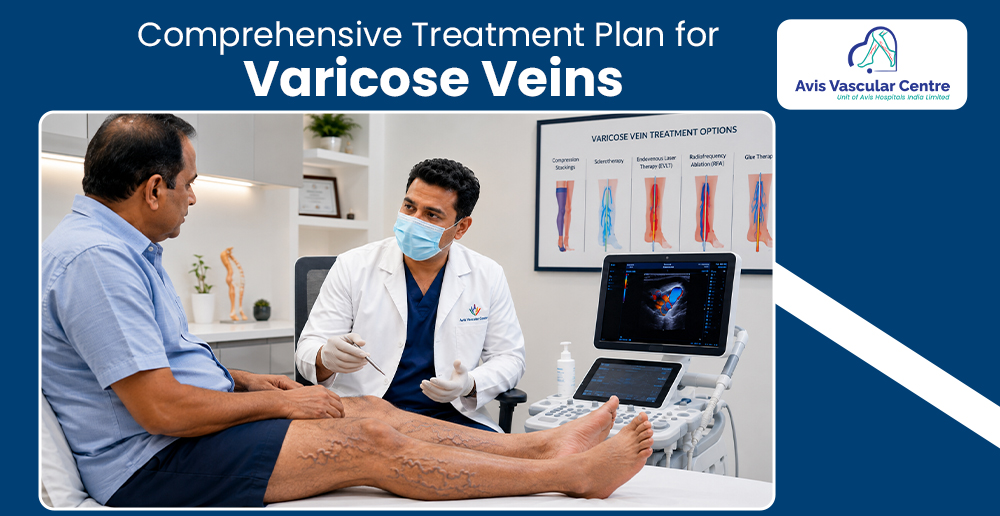
Why a Single Solution Rarely Works
When your veins' one-way valves deteriorate, blood might accumulate rather than return to the heart, resulting in varicose veins. This pooling might develop over years, be shallow or deep, and be minor or severe. This variation is ignored if every case is handled the same way or if surgery is performed right away. A diagnosis, not a prescription, is the first step in a true comprehensive approach.
Step One: A Proper Vascular Evaluation
Your vein system should be mapped using a Doppler ultrasound by a vein specialist before any therapy is recommended. The precise veins that are refluxing, the severity of the reflux, and whether deeper veins are involved are all displayed by this painless scan. When this stage is skipped, patients receive medications that just treat symptoms rather than the underlying cause, which is why veins frequently recur after a year or two.
Non-Surgical Options Come First
For most patients, non-surgical varicose vein treatment is the appropriate starting point. This can include:
• Compression therapy to reduce swelling and support circulation
• Sclerotherapy, where a solution is injected to close smaller veins
• Lifestyle adjustments - walking, weight management, and leg elevation
These approaches are minimally invasive, carry low downtime, and are often covered under day-care procedures. Most patients resume normal activity within a day or two.
When Advanced Vein Treatment Is Needed
First-line therapy is not always effective. Advanced vein treatment, such as radiofrequency ablation or, in certain situations, ambulatory phlebectomy, which removes vein clusters through tiny incisions, may be necessary for larger varicosities, recurring veins, or severe venous insufficiency. Although they are still outpatient treatments, they require more careful planning, which is precisely why the initial Doppler evaluation is crucial.
Building Your Plan
Compression and lifestyle modifications to control symptoms on a daily basis, a surgical procedure to seal the source vein, and follow-up scans to verify the reflux has subsided are typically layered in a comprehensive plan rather than selecting just one. A single quick cure is never as long-lasting as this phased method, which is customized over several visits.
Conclusion
Our vascular experts at Avis Vascular Centre provide personalised treatment options looking at your individual health conditions. Procedures like Radiofrequency (RFA) ablation are successfully performed at Avis vascular center for the treatment of veins, and these have been proven effective to seal off the defective veins and reroute the blood flow through the healthier veins. For more details, contact Avis Vascular Center at the earliest.
Frequently Asked
Questions
For any unanswered questions, reach out to our support team via email. We’ll respond as soon as possible to assist you.
For Enquiry
✉
info@avisvascularcentre.com
☎
+91 80089 49900
What is the best treatment for varicose veins?
−
The response varies depending on the size of the vein, the symptoms, and the Doppler results. While bigger,
symptomatic veins typically require laser or radiofrequency ablation, small veins frequently respond well to
sclerotherapy.
Is non-surgical treatment for varicose veins effective?
+
Indeed, for a large number of patients. Although they are less appropriate for larger, refluxing veins,
compression therapy and sclerotherapy can successfully treat smaller veins and early-stage symptoms.
How do I know which vein therapy is right for me?
+
The only reliable method is a Doppler ultrasonography performed by a trained vein specialist. It pinpoints
the precise veins that are impacted and directs the decision between advanced and non-surgical treatments.
Are advanced vein treatments painful or require downtime?
+
The majority of advanced methods, such as radiofrequency ablation and EVLT, are performed under local
anesthesia with little discomfort. In a day or two, patients usually resume their regular activities.