Two persons may have practically identical twisted veins on the calf. In one, the trouble begins in a defective valve high up in the groin; in the other it is confined to little surface branches. Treat them both the same and you'll likely see the veins come back.
This difference is not obvious to the naked eye. That’s why screening with Color Doppler is the backbone of current varicose vein therapy.
The Role of Color Doppler Screening in Varicose Veins
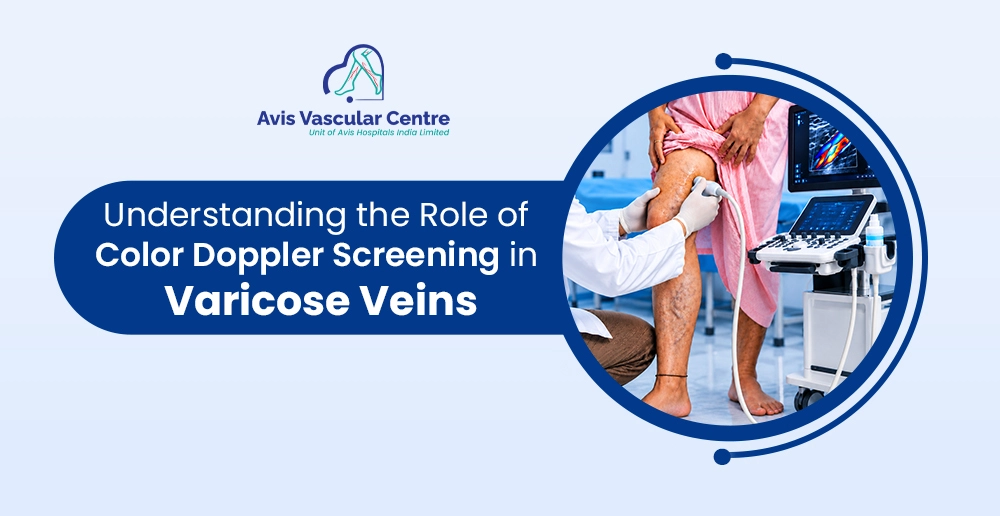
What Color Doppler Screening Actually Measures
The Screening is technically a duplex ultrasound, which combines the grayscale, showing the size and walls of a vein and whether there is a clot present, with the Doppler, which color-codes blood according to the direction it is traveling.
Healthy leg veins exclusively convey blood back to the heart. When valves fail, there is a transient backward flow of blood in a pattern called reflux. Generally, more than 0.5 seconds in the surface veins or more than 1 second in the primary deep veins of the thigh and knee is deemed abnormal reflux.
This is the reason why international recommendations such as the European Society for Vascular Surgery advocate duplex ultrasonography as the first-line test in suspected venous illness.
What happens during the Screening ?
You lie or stand on a slanting table, because it is against gravity that reflux is best seen. The sonographer will run a probe up and down from your crotch to ankle, squeeze your calf or tell you to bear down and see how the blood reacts. No needles, no radiation, no fasting. The process takes only 20 to 40 minutes.
Four Jobs That Doppler Performs in Your Treatment
Confirms diagnosis It excludes deep vein thrombosis and other causes of leg pain.
Finds the source It maps reflux back to the saphenous junctions or perforator veins and gives your specialist a map of what is happening.
Guides the process Laser or radiofrequency treatment uses live ultrasound to place the fiber and numbing fluid
Better results A follow-up Screening ensures that the vein is sealed and no clot has gone into the deep veins.
How to Read Your Doppler Report
Your report will usually tell you which veins are refluxing and for how long, the size of the main saphenous veins and whether there is any leakage at the connections in the groin and behind the knee. It also detects any bad perforator veins, and if the deep veins are clear of clots or scarring from a previous one.
Your specialist uses the findings to grade the condition and select which vein to treat, the best technique to use, and what may be left alone.
Doctors Insights
The veins a patient shows me are the finish, not the beginning. The actual leak is often just inches away, sometimes near the groin area. Without a Doppler map, treatment is guesswork. Guesswork is why veins come back. - Vascular Specialist, Avis Vascular Center
Conclusion
A plumber never finds a leak until he stops to look for it. A Color Doppler Screening converts guessing into a precise plan and fewer recurrences. Every treatment at Avis Vascular Center starts with a thorough Doppler assessment and is guided by ultrasound from start to finish so our minimally invasive walk-in walk-out alternatives are personalized to your veins.
Frequently Asked
Questions
For any unanswered questions, reach out to our support team via email. We’ll respond as soon as possible to assist you.
For Enquiry
✉
info@avisvascularcentre.com
☎
+91 80089 49900
Will a Color Doppler screening hurt me?
−
No. You will just feel the slight pressure and the probe on your leg.
If my veins are purely cosmetic, do I require a Screening ?
+
Yes. There can be reflux hiding under small spider veins. Treating only the spider veins often causes them to come back.
Is it safe while pregnant?
+
Yes. Doppler ultrasonography employs sound waves, not radiation.
Will I have to have another Screening following treatment?
+
Yes. A follow-up Screening examines for any clot and checks the treated vein is closed.