Blog > Diagnosis and Treatment > Varicose Veins Treatment with AR Technology (CLaCS)
Varicose Veins Treatment with AR Technology (CLaCS)
18-October-2025Category: Diagnosis and Treatment
Varicose veins are a common vascular condition that affects millions of people worldwide.
Characterized by enlarged, twisted veins often visible beneath the skin’s surface, varicose
veins can cause discomfort, pain, and cosmetic concerns. While traditional treatment options
such as sclerotherapy and vein ablation have been effective, recent advancements in medical
technology have led to the development of innovative approaches, including Augmented Reality
(AR) technology in conjunction with Cryo Laser and Cryo Sclerotherapy (CLaCS). In this blog, we
will elucidate the new-age treatment of varicose veins using CLaCS and explore the
research-based study results supporting its efficacy.
Get Your First Doppler Scan FREE — Worth ₹4,500!
Understanding CLaCS Treatment:
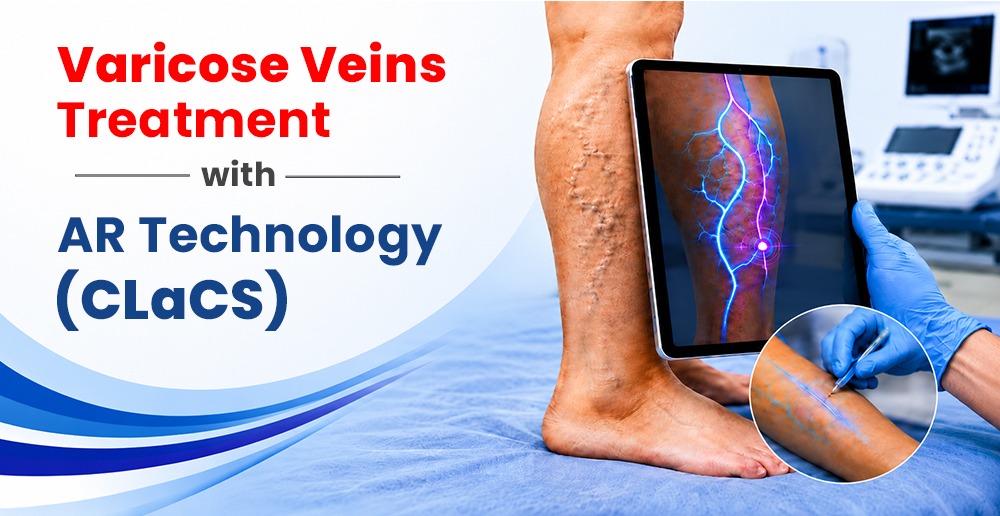
CLaCS treatment combines Cryo Laser and Cryo Sclerotherapy with the precision of Augmented
Reality technology to target and treat varicose veins more effectively. Cryo Laser involves the
use of laser energy to heat and seal off the affected veins, while Cryo Sclerotherapy utilizes a
cold agent to induce sclerosis and collapse the veins. Augmented Reality technology enhances the
accuracy and precision of treatment by providing real-time visualization of the veins overlaid
onto the patient’s skin, allowing for precise targeting and treatment delivery.
Confused about treatment options? Our experts will guide you step by step.
Research-Based Study Results on CLaCS Treatment:
Numerous research studies have investigated the efficacy and outcomes of CLaCS treatment for
varicose veins, yielding promising results:
Improved Precision and Accuracy: A study published in the Journal of Vascular
Surgery found that
CLaCS treatment with Augmented Reality technology significantly improved the precision and
accuracy of vein targeting compared to traditional methods. Real-time visualization of the veins
allowed for precise placement of the laser and sclerotherapy agents, resulting in more effective
treatment outcomes.
Reduced Treatment Time: Research conducted at leading vascular clinics
demonstrated that CLaCS
treatment with Augmented Reality technology led to a reduction in treatment time compared to
conventional methods. The ability to visualize and target veins more accurately allowed for
faster and more efficient treatment delivery, minimizing patient discomfort and enhancing
procedural efficiency.
Enhanced Patient Satisfaction: Multiple studies have reported high levels of
patient
satisfaction with CLaCS treatment using Augmented Reality technology. Patients appreciated the
personalized approach to treatment, as well as the reduced pain, faster recovery, and improved
cosmetic outcomes associated with CLaCS compared to traditional methods.
Reduced Risk of Complications: Research findings published in the European
Journal of Vascular
and Endovascular Surgery indicated that CLaCS treatment with Augmented Reality technology was
associated with a reduced risk of complications such as bruising, swelling, and nerve injury
compared to conventional methods. The precise targeting and minimally invasive nature of CLaCS
contributed to improved safety and patient outcomes.
The integration of Augmented Reality technology with Cryo Laser and Cryo Sclerotherapy
represents a new frontier in the treatment of varicose veins. Research-based study results
support the efficacy, precision, and safety of CLaCS treatment, offering patients a minimally
invasive and highly effective alternative to traditional methods.
As technology continues to advance, CLaCS treatment with Augmented Reality holds promise for
revolutionizing the management of varicose veins and improving patient outcomes in the modern
era. The treatment is currently offered at Avis Vascular Center and performed by our expert
interventional radiologists. Call today to find out if this option is suitable for your Vein
condition
Interventional Treatment Options
While anticoagulants are the cornerstone of DVT treatment, interventional therapies are crucial
for patients who cannot take these medications or those with extensive clot burden. Here are
some key interventional treatments
Sclerotherapy:
Sclerotherapy is another treatment option for varicose veins associated with DVT. It involves
injecting a sclerosant solution directly into the vein, causing it to collapse and be reabsorbed
by the body. This procedure helps reduce venous stasis and the risk of clot formation, thereby
managing and preventing DVT.
Balloon Angioplasty and Stenting:
In cases where DVT causes significant narrowing of the veins, balloon angioplasty and stenting
can help. This procedure involves inflating a small balloon within the vein to open it up and
placing a stent to keep it open. This treatment restores proper blood flow and reduces the risk
of recurrent DVT.
Interventional treatments for DVT are vital for managing patients with severe or complicated
cases. These procedures offer rapid symptom relief, prevent serious complications, and improve
long-term outcomes. Prompt recognition and treatment of DVT are essential to avoid potentially
life-threatening consequences. If you suspect you have DVT or are at high risk, consult our
expert interventional radiologists at Avis vascular center and know your treatment options.
For any unanswered questions, reach out to our support team via
email. We’ll respond as soon as possible to assist you.
For Enquiry
✉
info@avisvascularcentre.com
☎
+91 80089 49900
What makes CLaCS different from traditional varicose vein treatments?
−
CLaCS combines laser, sclerotherapy, cooling technology, and AR visualization, allowing more
precise vein targeting with less discomfort and faster recovery.
How does Augmented Reality help in varicose vein treatment?
+
AR projects real-time vein maps onto the skin, helping doctors accurately identify and treat
veins that are not visible to the naked eye.
Is CLaCS treatment painful?
+
The cooling (cryo) component significantly reduces pain, making the procedure more comfortable
than conventional laser or injection-based treatments.
How long does recovery take after CLaCS treatment?
+
Most patients resume normal activities the same day or the next day, with minimal swelling or
bruising.
Is CLaCS suitable for all varicose veins?
+
CLaCS is ideal for spider veins and small-to-medium varicose veins; suitability is confirmed
after a detailed vein evaluation.