Your doctor mentions “reflux” on a scan report. Chronic venous insufficiency is discussed in a clinic brochure. A friend claims that "incompetent valves" are the cause of her varicose veins. Although it's simple to think that these are all just various names for the same thing, they're not, and the distinction does significant. One is a silent mechanical malfunction occurring within a venous valve. The other is the full-blown illness that, if no one notices it, could develop years later. When you understand the difference, a Doppler report ceases to be confusing jargon and becomes a map that shows you exactly where you stand and what has to be done.
Venous Incompetence vs. Chronic Venous Insufficiency: What's the Difference?
What Is Venous Incompetence?
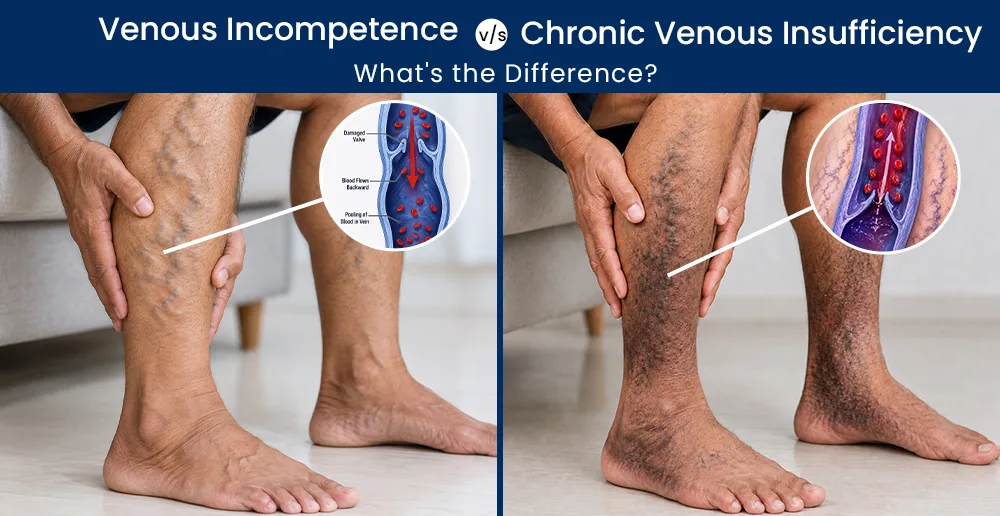
Imagine your legs' veins as a one-way blood staircase, with small trapdoor valves placed every few centimeters to prevent blood from falling back down due to gravity. When one or more of such trapdoors fail to close correctly, venous incompetence results. Venous reflux is the term for the phenomenon when blood that should be flowing upward toward the heart instead flows backward and pools. This is a purely mechanical issue, the kind that a Color Doppler scan illuminates in real time. What amazes most people is that it can remain silent for years without generating any discomfort or obvious symptoms, long before it ever manifests as a "problem" that you would detect on your own.
What Is Chronic Venous Insufficiency (CVI)?
If you allow that silent mechanical malfunction to persist for an extended period of time, you will develop chronic venous insufficiency. The pressure in your leg veins is kept high every day by blood that continues to pool rather than flow, and eventually this pressure begins to push outward into the surrounding tissue. At this point, vein problems cease to be undetectable and manifest as swelling, heaviness, discolored skin, and in more severe cases, the tenacious ulcers that people typically associate with "bad veins." To put it succinctly, CVI is the potential earthquake caused by ineptitude, which is the fault line.
Chronic Venous Insufficiency Symptoms
This is the checklist worth keeping in the back of your mind — not to self-diagnose, but to know when it's time to stop shrugging things off and book a scan:
• Persistent swelling in the lower legs or ankles, which is frequently worse in the evening;
• A feeling of exhaustion, pain, or heaviness in the legs after standing; visible spider or varicose veins
• Brownish or reddish discoloration of the skin around the ankles
• Thickened, dry, or itchy skin (a condition known as lipodermatosclerosis)
• Leg cramps or restless legs, especially at night
In advanced cases, slow-healing wounds or ulcers close to the ankle
Venous Incompetence vs. CVI: Side by Side
Still not sure which one applies to you? Here's the whole comparison laid out at a glance:
| Aspect | Venous Incompetence | Chronic Venous Insufficiency |
|---|---|---|
| What it is | A valve-level malfunction causing blood reflux | A disease state resulting from long-term reflux |
| Stage | Can be an early, silent finding | Represents a more advanced, symptomatic stage |
| Symptoms | Often none, or mild heaviness | Swelling, skin changes, pain, possible ulcers |
| Detected by | Color Doppler scan showing reflux | Clinical exam plus Doppler confirmation |
| Typical management | Monitoring, compression, lifestyle changes | Compression, medication, procedural treatment |
Venous Insufficiency Treatment Options
The good news: nothing on this spectrum is a life sentence. Treatment simply scales to where you are — from a silent finding you'll just keep an eye on, to symptomatic CVI that needs a more active plan:
✓ Compression therapy: To improve venous return and reduce swelling, graduated compression stockings continue to be the first-line treatment at every stage.
✓ Lifestyle strategies: Walking frequently, elevating one's legs, controlling one's weight, and avoiding extended standing all aid in slowing the progression.
✓ Once reflux is proven and symptomatic, minimally invasive treatments like radiofrequency or laser ablation block the defective vein.
✓ Sclerotherapy: Used for smaller varicose or spider veins, often alongside other treatments.
✓ Wound care: For advanced CVI with ulceration, specialised dressings and compression bandaging support healing alongside treating the underlying reflux.
Conclusion
Understanding the distinction between venous incompetence and chronic venous insufficiency enables you to take vein health seriously before symptoms worsen. Venous incompetence is a mechanical finding, while chronic venous insufficiency is a long-term consequence. With the help of cutting-edge Color Doppler diagnostics, Avis Vascular Center specializes in detecting venous incompetence at its earliest, most treatable stage. Skilled vascular specialists then create a treatment plan tailored to your specific position on that spectrum. Avis Vascular Center provides accurate diagnosis and all-encompassing vein care under one roof, whether it's a first screening or continuous CVI management.
Frequently Asked
Questions
For any unanswered questions, reach out to our support team via email. We’ll respond as soon as possible to assist you.