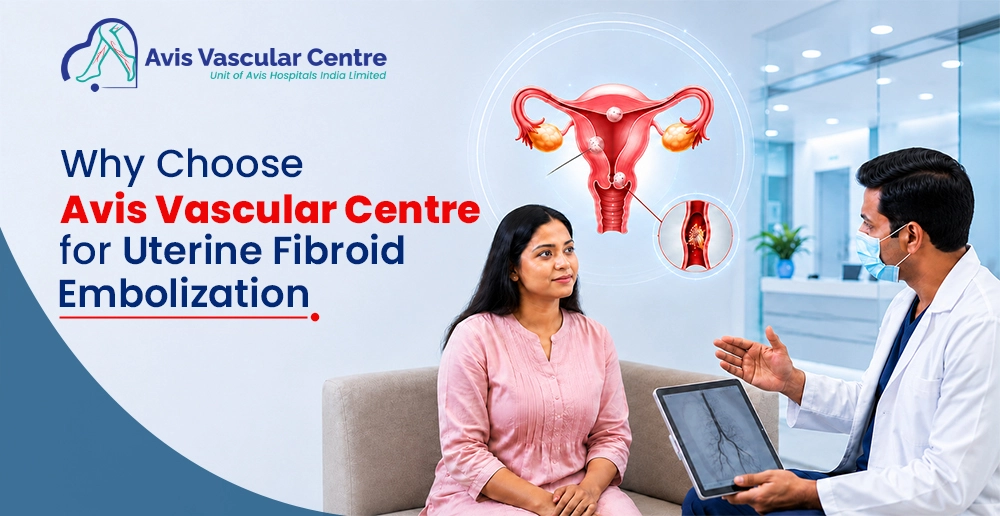
Blog > Vascular Diseases > Why Choose Avis Vascular Centre for Uterine Fibroid Embolization
Uterine fibroids are non-cancerous growths made up of muscle and fibrous tissue that form in or
around the uterine wall. Because fibroids can range in size from pea-sized and symptomless to
large enough to cause heavy periods, pelvic pain, pressure on the bladder or intestines, and
even fertility issues, many women get at least one at some point, frequently without ever
realizing it. They tend to naturally diminish after menopause, however the exact explanation is
unknown. Age, hormones, and heredity all seem to play a part.
For many years, receiving a fibroid diagnosis nearly always meant discussing surgery, either a
hysterectomy to remove the uterus entirely or a myomectomy to remove the fibroids. Uterine
fibroid embolization (UFE) a non-surgical fibroid treatment that decreases fibroids by
cutting
off their blood supply without requiring a single surgical incision, is a third alternative that
has been subtly demonstrating its effectiveness for more than 25 years, but fewer women are
informed about it. When considering your alternatives, it's important to know exactly what UFE
entails and why the team doing it is just as important as the process itself.
How the Fibroid Embolization Procedure Works
1. Access — A tiny catheter is guided in through a small entry point in the wrist or
groin — no
abdominal incision at any point.
2. Embolization — Guided by real-time imaging, the interventional radiologist releases
tiny
particles into the vessels feeding the fibroid, cutting off its blood supply precisely.
3. Recovery — Fibroids shrink gradually over the following weeks as the uterus itself is
left
completely untouched, and most women are back to normal activity within 1–2 weeks.
Why Choose Avis Vascular Centre for This Procedure
✓ Dedicated interventional radiology expertise: Our interventional radiologists
undertake
image-guided embolization treatments as a fundamental component of their profession; UFE is a
specialized skill that differs from general gynecology or vascular surgery.
✓ Advanced imaging for accuracy: By ensuring that the catheter reaches precisely the proper
vessels, real-time imaging guidance reduces the risk to surrounding tissue and improves results.
✓ A truly non-surgical fibroid therapy involves a same-day or overnight hospital stay rather
than a multi-day admission, no abdominal incision, and no general anesthesia for the majority of
patients.
✓ Prioritizing fertility and uterine preservation: Unlike myomectomy, UFE does not involve
cutting into uterine tissue, and unlike hysterectomy, it fully retains the uterus.
✓ All-inclusive imaging and vascular assistance in one location: Care is coordinated rather than
dispersed across several specialists and facilities, from the first pelvic imaging to the actual
embolization surgery and follow-up scans.
✓ A team that outlines all of your choices: Every patient is guided through UFE along with
surgical options, ensuring that the decision is truly informed rather than left to the whichever
physician happens to be in the room.
Who Is a Good Candidate for UFE?
✓ Women who have pelvic pressure, pain from proven fibroids, or heavy or protracted periods
✓ People who wish to avoid general anesthesia or major surgery wherever possible
✓ Women who wish to preserve their uterus, whether or not future fertility is a priority
✓ When a patient has several fibroids, it is better to treat them all at once rather than having
them removed repeatedly.
✓ Anyone who wants a second, non-surgical opinion before making a decision after being presented
with solely surgical choices
Conclusion
Surgery is not the sole option if you are diagnosed with fibroids. For ladies seeking
comfort without losing their uterus or having to endure a protracted recuperation, Avis
Vascular Center offers specialized interventional radiology expertise, cutting-edge
image-guided equipment, and a truly non-surgical fibroid treatment alternative. Avis
Vascular Center is designed to ensure that you comprehend all of your options and choose the
one that is truly best for you, starting with your initial consultation and continuing
through the embolization process and aftercare.